
Luxury Watch Guide · Collector’s Edition · Investment Watches
Every collector starts somewhere. Maybe it was a Rolex on a parent’s wrist, or a glance at a magazine spread that made something click. Over time, though, the vocabulary expands. The references get more specific. The questions get harder to answer. And slowly, a list forms — the watches that define what serious collecting actually looks like.
This guide covers ten of those watches. Some are icons that shaped the entire industry. Others are the kind of pieces that only reveal themselves to collectors who have done the reading. All of them, however, belong on the radar of anyone who takes luxury watchmaking seriously.
1. Patek Philippe Nautilus 5711/1A — The Watch That Defined a Generation
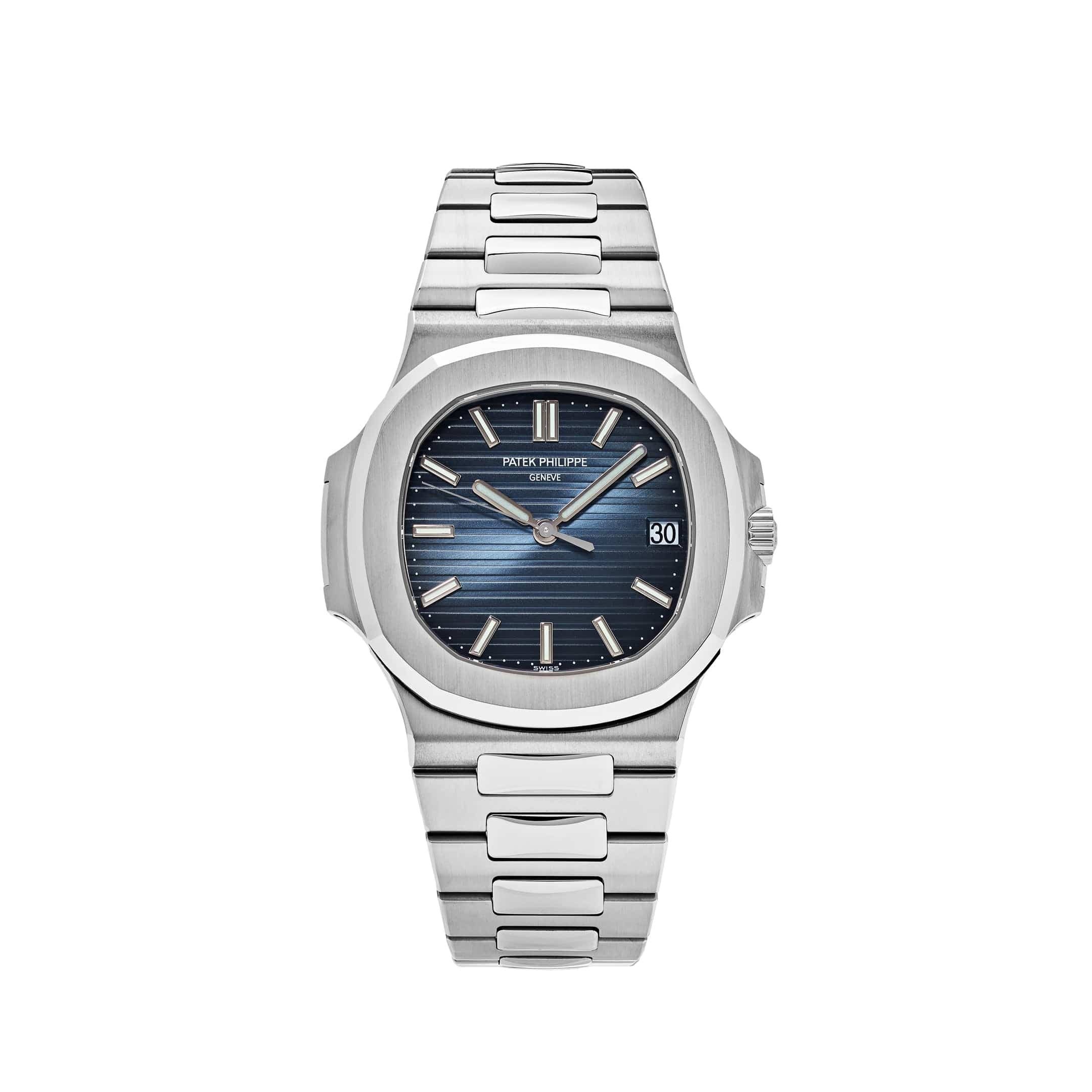
There is no list of important luxury watches that does not begin here. The Patek Philippe Nautilus 5711/1A is, without question, the most culturally significant sports watch of the past twenty-five years. Gerald Genta designed the original Nautilus in 1976 as a luxury sports watch in steel — a concept that was genuinely radical at the time. However, it was the 5711 generation, introduced in 2006, that turned the Nautilus into a global phenomenon.
The 5711/1A features a 40mm stainless steel case, the iconic porthole-inspired bezel with integrated stepped lugs, and the horizontal embossed blue dial that has become one of the most recognizable faces in watchmaking. Inside sits caliber 324 SC, a self-winding movement with a date function and a 45-hour power reserve.
Patek Philippe discontinued the 5711/1A in 2021, which sent secondary market prices to extraordinary levels. At its peak, the watch traded at five to six times its retail price on the open market. Even today, it remains a benchmark reference for everything the luxury sports watch category represents. For any serious collector, understanding the 5711 is not optional — it is foundational.
Why it matters: The 5711/1A proves that steel, correctly executed, can command more desire than gold. Furthermore, it demonstrated that a discontinued reference can define an entire segment of the collector market for years.
Key details: Stainless steel, 40mm, caliber 324 SC, blue dial, integrated bracelet.
2. Patek Philippe Nautilus 5711/1P — The Platinum Chapter
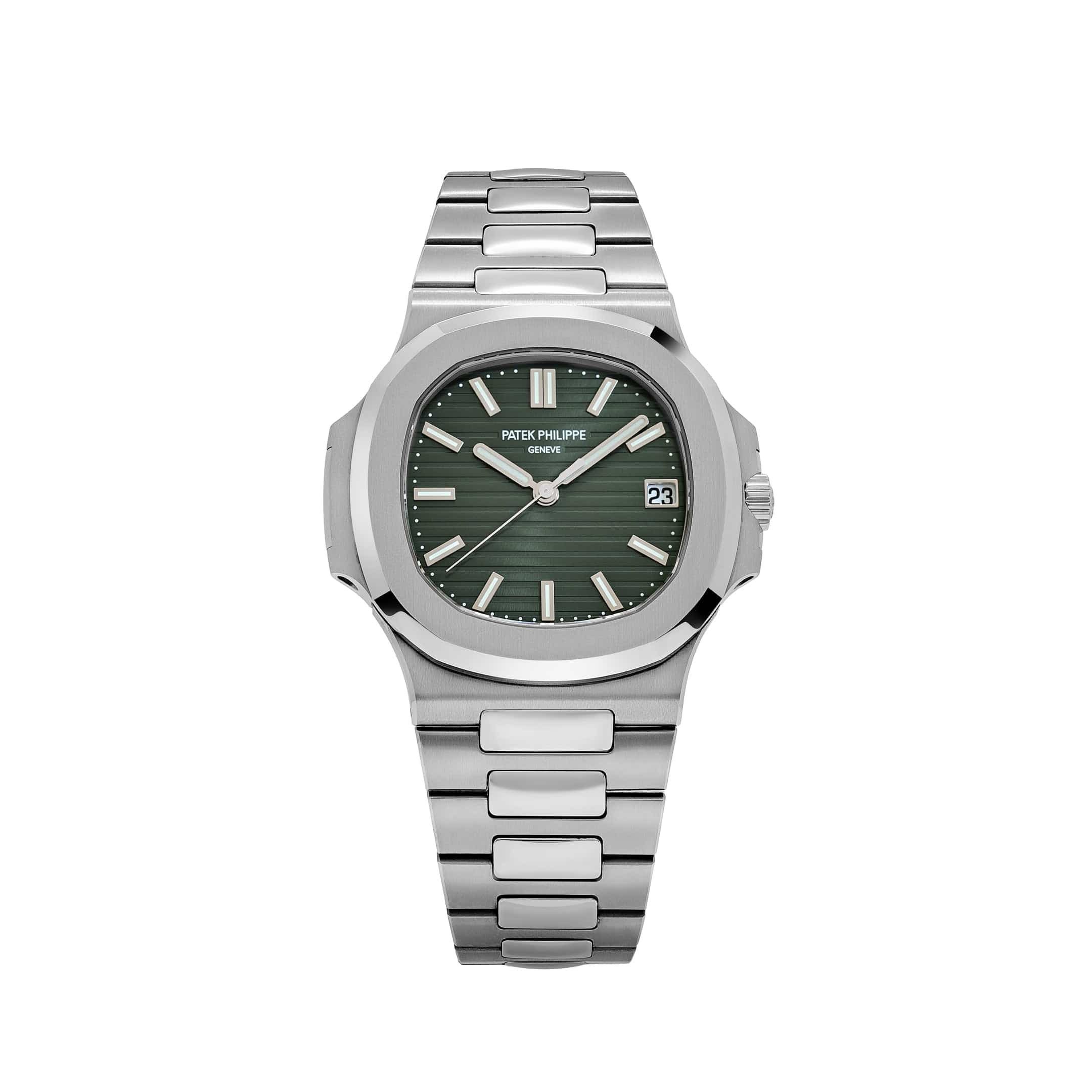
If the 5711/1A in steel is the reference every collector knows, the 5711/1P in platinum is the one they aspire to. Patek Philippe introduced this variant with a slate gray dial — a color exclusive to the platinum version — that has since become one of the most admired dials in the entire Nautilus catalog.
Platinum gives the case a cooler, denser quality than steel. The difference in weight is immediately apparent when you pick it up. Moreover, the gray dial develops differently under different light sources, shifting from a neutral tone in low light to a quietly complex surface in direct daylight, where the horizontal embossing catches and scatters the light in a way that photographs rarely capture accurately.
The 5711/1P was produced in limited quantities and was never an easy watch to acquire. Consequently, its secondary market presence is even rarer than the steel reference, and its collector appeal is significantly stronger among those who seek the most refined iteration of an already exceptional design.
Why it matters: The platinum 5711 shows how material choice can transform a familiar silhouette into something entirely different. It also represents the upper limit of what Patek Philippe offered within the Nautilus sports context.
Key details: Platinum case, gray slate dial, 40mm, caliber 324 SC, integrated platinum bracelet.
3. F.P. Journe Chronomètre à Résonance — The Watch That Uses Physics
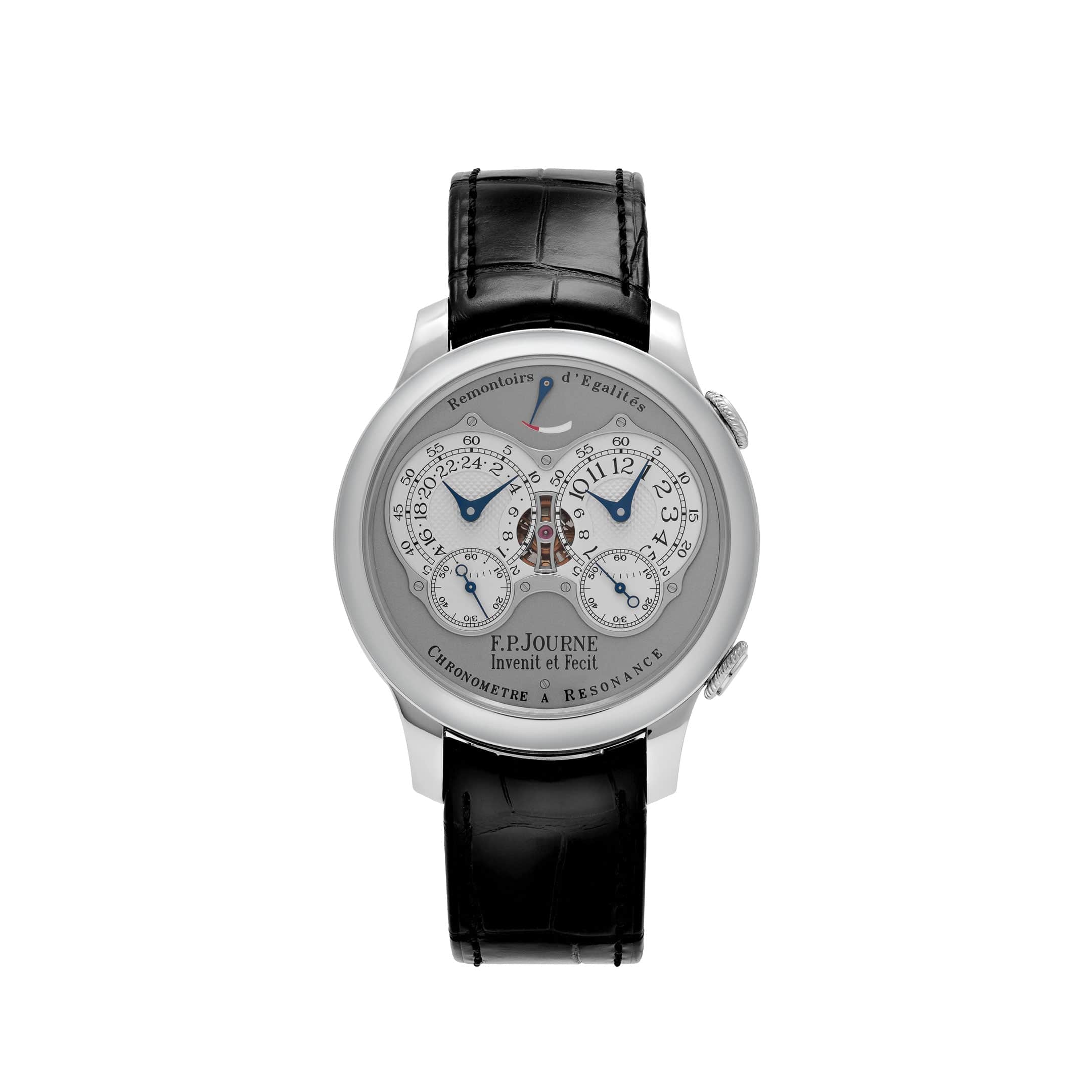
Most complicated watches impress through visible mechanical theatre. The F.P. Journe Chronomètre à Résonance impresses through a principle of physics that most people learn about in school and then forget: acoustic resonance. When two oscillators are placed in close proximity and share a medium, they synchronize. Journe built a watch around this phenomenon, placing two independent balance wheels in the same movement so that they naturally lock into opposition — beating against each other — to produce superior chronometric accuracy.
This is not a gimmick. Resonance in watchmaking was first documented by the 17th-century master Antide Janvier. However, no modern manufacturer had successfully produced a commercial resonance watch before Journe. The result is a movement of exceptional precision, where the two oscillators correct each other’s errors rather than accumulating them independently.
The dial is a study in perfect bilateral symmetry: two time zones, two independent gear trains, two balance wheels visible through twin apertures, all arranged around a central vertical axis. It is, simultaneously, one of the most technically advanced and most visually coherent watch dials ever made. Additionally, because F.P. Journe produces everything in-house in extremely limited quantities, the Résonance remains genuinely rare and genuinely difficult to acquire.
Why it matters: The Chronomètre à Résonance proves that the most interesting ideas in watchmaking come from independent manufacturers who are not constrained by committee decisions. It is the definitive example of what “Invenit et Fecit” — invented and made — actually means.
Key details: Resonance movement, dual time zone, 18K gold movement, available in titanium or gold cases, hand-wound.
4. F.P. Journe Tourbillon Souverain — The Definitive Independent Tourbillon
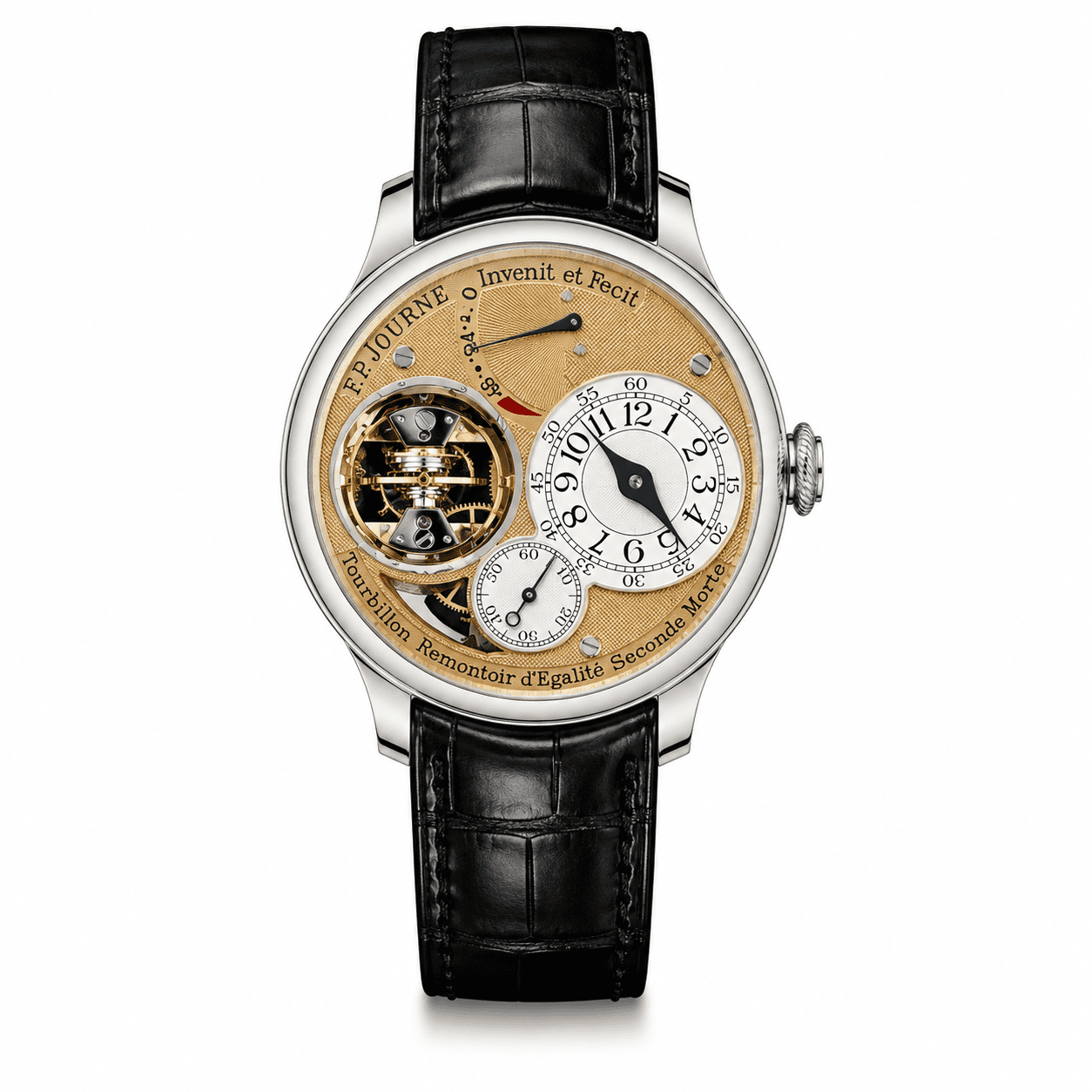
The tourbillon is one of watchmaking’s oldest and most debated complications. Invented by Abraham-Louis Breguet in 1801 to counteract the effects of gravity on a pocket watch held vertically, it has since become simultaneously the most technically demanding and most frequently misunderstood complication in the industry.
F.P. Journe’s Tourbillon Souverain adds something that no other tourbillon wristwatch offered at the time of its introduction: a remontoir d’égalité, or constant-force device. This small mechanism, positioned between the mainspring and the escapement, releases a fixed, identical amount of energy to the balance wheel at regular intervals. As a result, the tourbillon always receives consistent energy regardless of the varying tension in the mainspring. This is mechanically superior to a standard tourbillon, because it addresses a problem that the tourbillon alone cannot solve.
The Tourbillon Souverain is also notable for its dial layout. The large central tourbillon cage is immediately visible, but the remontoir — beating at the top of the movement — gives the watch a second point of live mechanical motion that most tourbillons do not offer. Together, they make this one of the most intellectually satisfying watches to observe in motion.
Why it matters: Serious collectors understand that not all tourbillons are equal. The Tourbillon Souverain demonstrates what a tourbillon actually needs to improve accuracy, rather than simply existing as a display of craft.
Key details: Tourbillon with remontoir d’égalité, 18K gold movement, titanium or gold case, hand-wound.
5. Cartier Crash — The Watch That Broke the Rules
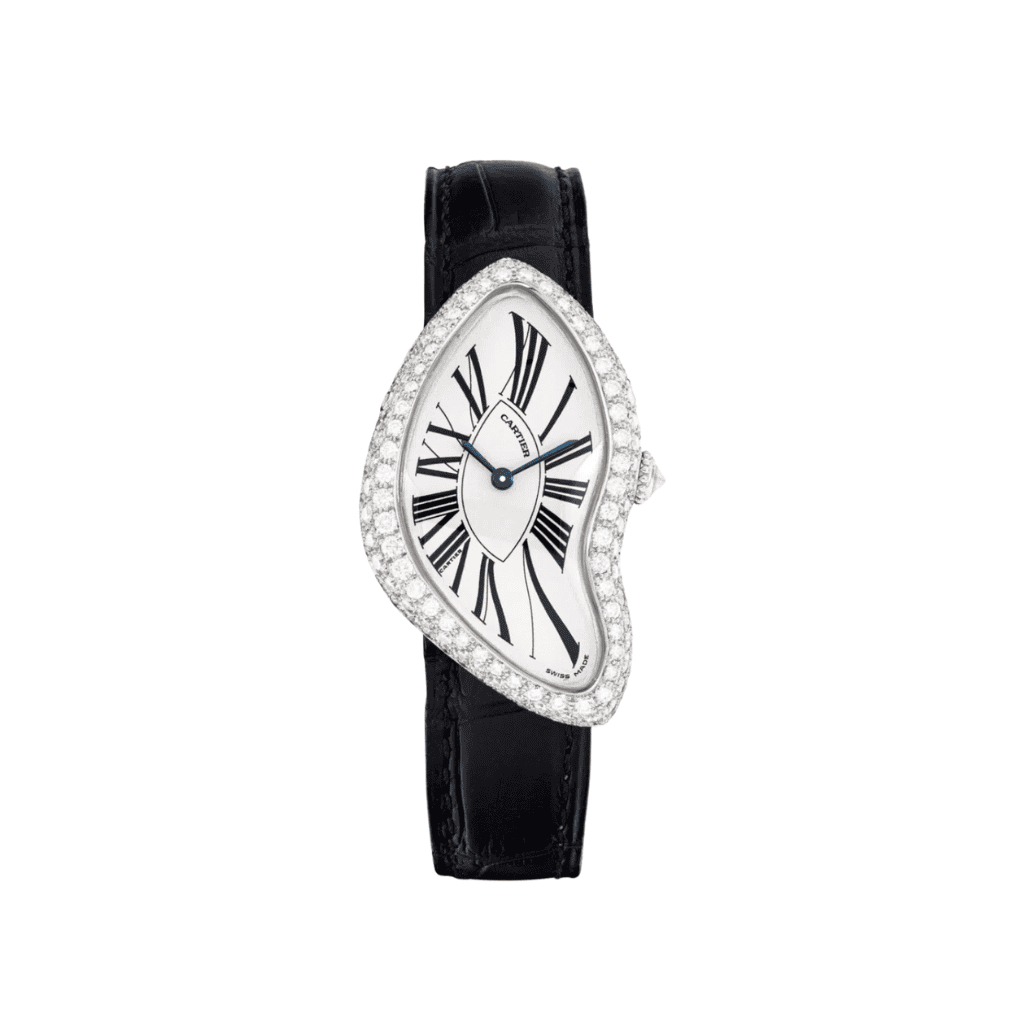
Most important watches are important because of what they do well. The Cartier Crash is important because of what it refuses to do at all. Introduced in 1967 — reportedly inspired by a real Cartier Baignoire that melted in a car fire — the Crash abandons every conventional expectation of case geometry, dial layout, and hand placement. The result is a watch that looks like time itself is distorting, and that is exactly the point.
The Crash is not trying to be precise. It is not trying to be legible. It is, instead, one of the very few watches that can legitimately claim to be a piece of wearable sculpture. The asymmetric case, the warped numerals, and the bent hands all serve a visual idea rather than a functional one. Furthermore, no two Crash cases look exactly alike because the asymmetry makes perfect repetition impossible.
Serious collectors who include the Crash in their collection are making a statement about what a watch can be. It sits alongside tourbillons and grand complications not because it shares their technical ambition, but because it asks a fundamentally different question: what if precision is not the point?
Why it matters: The Crash proves that a watch does not need a complicated movement to be a complicated object. It represents the jewelry side of watchmaking at its most audacious, and it has lost none of its capacity to surprise after more than fifty years.
Key details: Asymmetric case, hand-wound movement, London 1967 origin, produced in yellow gold, white gold, and rose gold variants.
6. Richard Mille RM 67-02 — Sport, Lightness, and Engineering
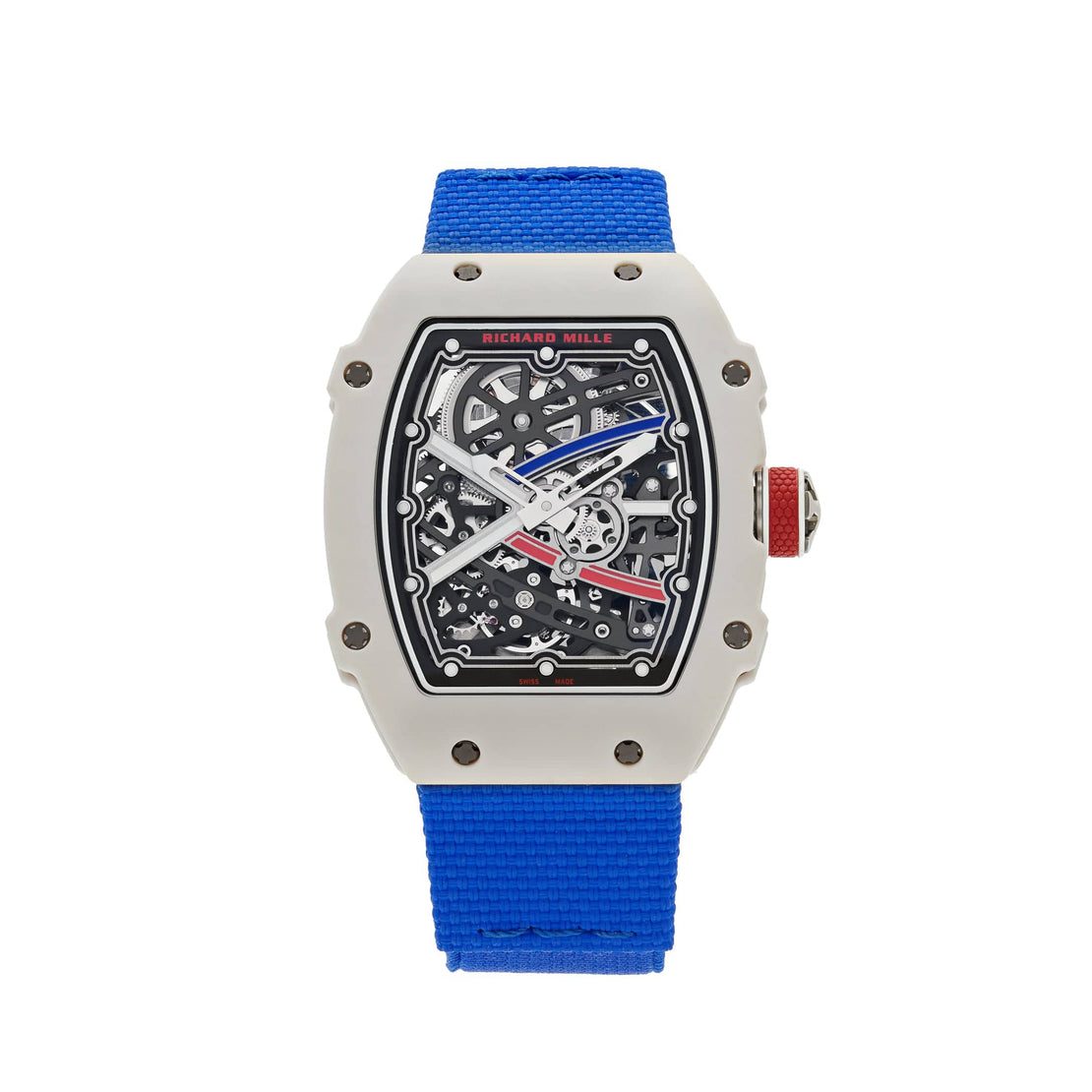
Richard Mille produces many impressive watches. However, the RM 67-02 is among the most revealing of what the brand genuinely does well. At 32 grams total, it is the lightest automatic Richard Mille ever made. The case uses Carbon TPT or Quartz TPT composite materials — proprietary to the brand — that are lighter and harder than titanium while providing exceptional shock resistance.
The movement, caliber CRMA7, uses grade 5 titanium base plate and bridges with black and gray DLC treatments. The entire structure is skeletonised, so the dial is effectively the movement itself, visible through the front crystal and through the sapphire caseback simultaneously. The athletic collaborations — Alexis Pinturault in white, Sébastien Ogier in black carbon — give each variant its own color language while sharing the same technical architecture.
For collectors entering Richard Mille for the first time, the RM 67-02 is often the most accessible starting point intellectually, if not financially. It distils what the brand stands for — performance engineering in watch form — without the further complexity of a tourbillon or split-seconds mechanism. Furthermore, the range of colors and materials available across the 67-02 family means there is a version for almost every collecting taste.
Why it matters: The RM 67-02 demonstrates that watchmaking can borrow directly from aerospace and motor sport engineering without becoming novelty. It is a sports watch in the most literal sense.
Key details: 32 grams, Carbon TPT or Quartz TPT case, caliber CRMA7, automatic, 50-hour power reserve, available in multiple athlete editions.
7. Audemars Piguet Royal Oak 15407ST — The Skeletonised Icon
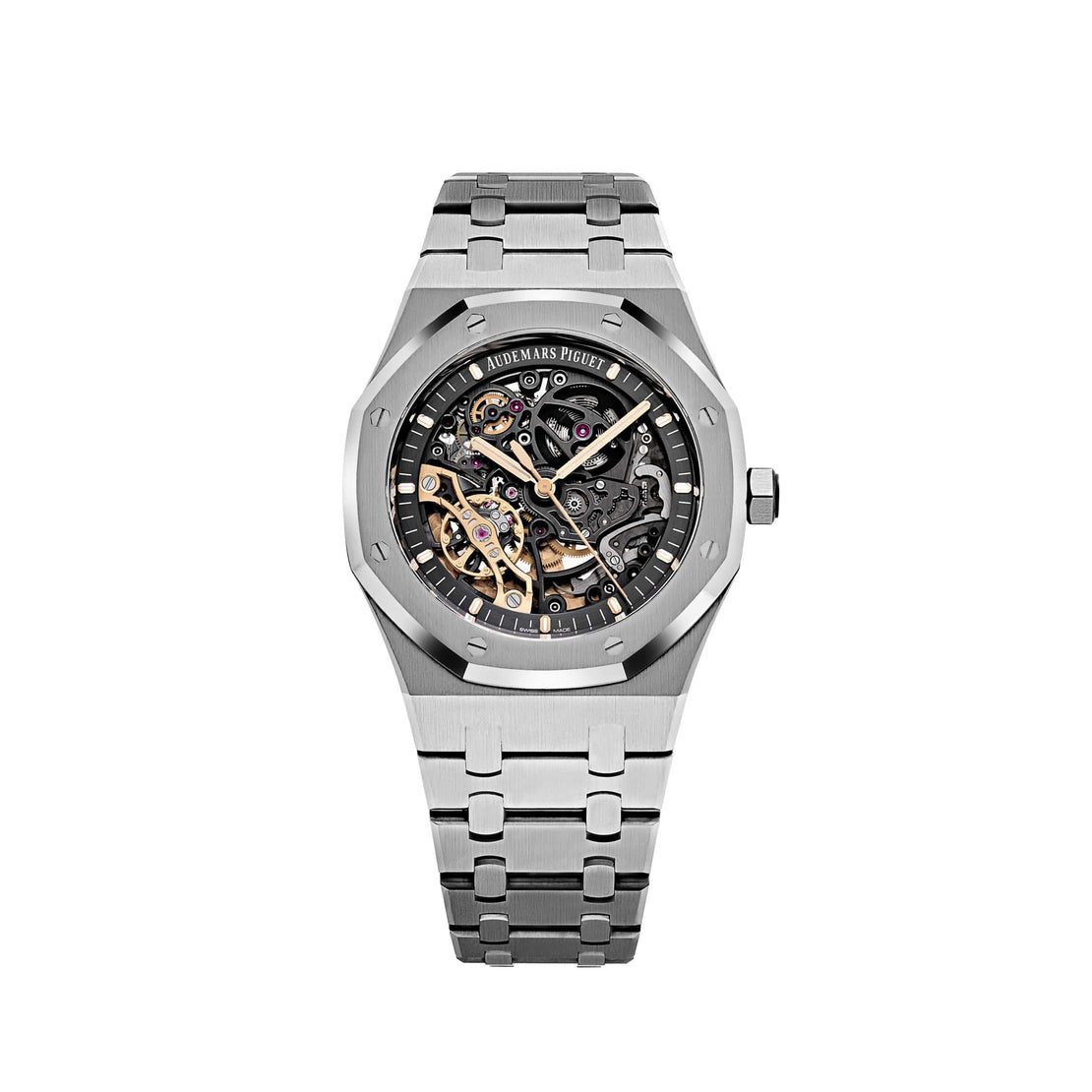
The Royal Oak needs little introduction to any collector. Gerald Genta’s 1972 design remains one of the most influential case silhouettes in watchmaking history. However, within the Royal Oak catalog, the 15407ST occupies a specific and genuinely important position: it is the skeletonised automatic in steel, and it is one of the most technically demanding production pieces Audemars Piguet makes.
Skeletonising a movement is not simply a matter of cutting away material. Each bridge and plate must be individually recalculated to ensure that removing metal does not compromise structural integrity or precision. The finishing then demands that every new edge and surface created by the milling process is hand-chambered, polished, and decorated to the same standard as the original components. On the 15407ST, this process is applied to the entire movement, which remains visible front and back through sapphire crystals.
The result is a Royal Oak where the iconic tapisserie dial has been replaced entirely by the movement itself. The octagonal bezel, the integrated bracelet, and the Grande Tapisserie pattern of the standard Royal Oak are all gone. Instead, the familiar silhouette frames a mechanical landscape of bevelled bridges, skeletonised wheels, and the oscillating balance wheel at 9 o’clock.
Why it matters: The 15407ST shows what the Royal Oak looks like when form serves the movement rather than hiding it. For collectors who want the icon and the engineering simultaneously, this is one of the most satisfying answers in the Audemars Piguet catalog.
Key details: Stainless steel, 41mm, skeletonised automatic movement, caliber 3132, sapphire front and back.
8. Kari Voutilainen 28 Sport — The Independent Watch That Changes Minds
Of all the watches on this list, the Kari Voutilainen 28 Sport is probably the least familiar to collectors new to the independent segment. That is precisely why it belongs here. Voutilainen is a Finnish watchmaker working from a small atelier in Môtiers, Switzerland, who produces approximately fifty watches per year, entirely by hand, to a standard of finishing that routinely leaves experienced collectors at a loss for words.
The 28 Sport takes Voutilainen’s house aesthetic — extraordinarily detailed hand guilloché dials, impeccably finished ebauches, and a quiet refusal to shout for attention — and places it in a more robust, slightly sportier case than his dress references. The result is a watch that can be worn daily without anxiety and examined under a loupe without disappointment. Furthermore, the hand guilloché dials, each produced by Voutilainen himself on antique rose engine machines, mean that no two watches are visually identical.
Waiting lists for Voutilainen are long and move slowly. Consequently, acquiring one requires patience, a direct relationship with the watchmaker, and a genuine commitment to the independent watchmaking world. For collectors who make that investment, the 28 Sport often becomes the most treasured piece in their collection — because it represents what one person, working alone, can achieve.
Why it matters: Voutilainen proves that the finest watchmaking in the world is not necessarily produced by the largest manufacturers. The 28 Sport is the entry point for collectors who want to understand what truly independent watchmaking looks like.
Key details: Hand guilloché dial, in-house movement, approximately 50 pieces per year, available by allocation only.
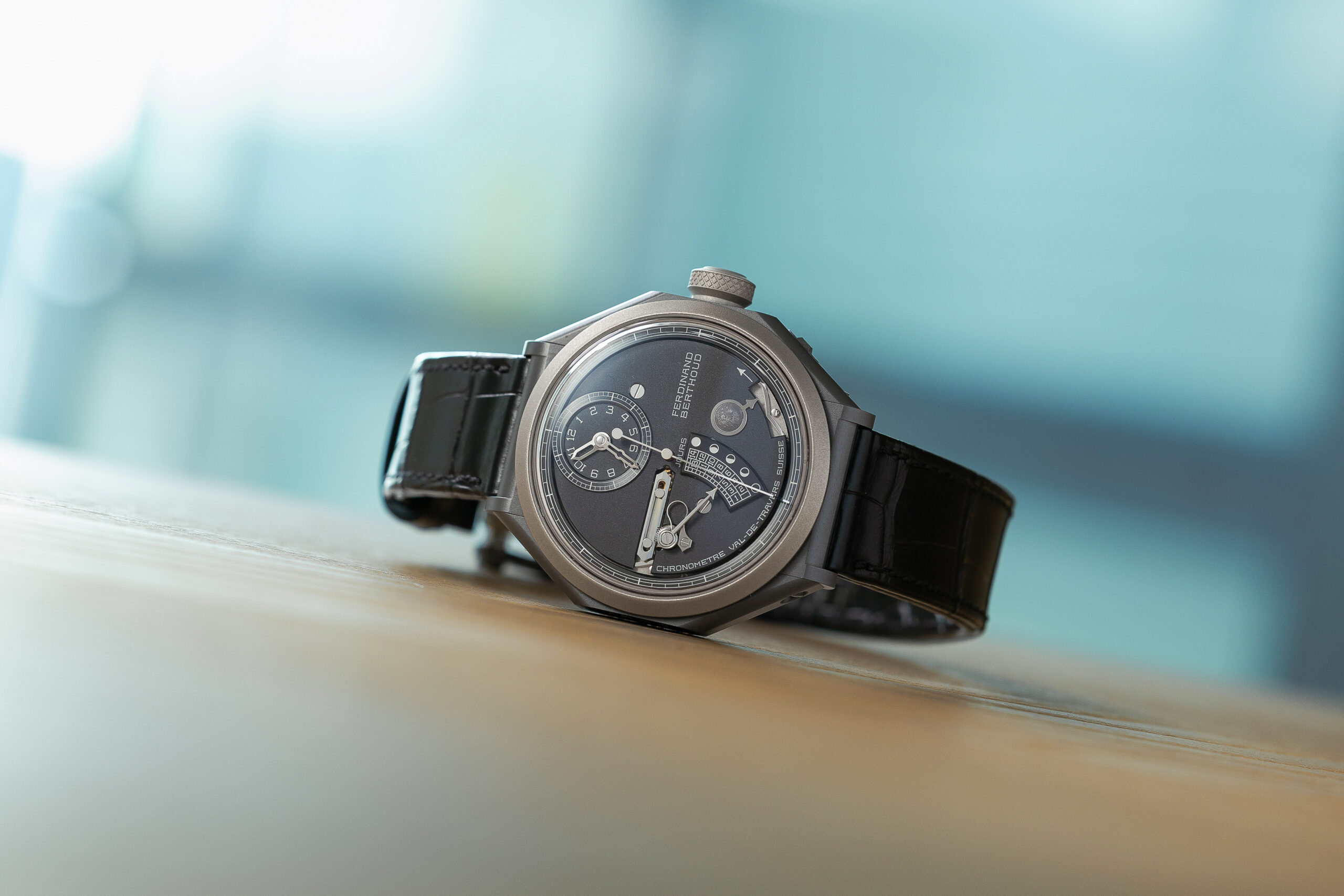
9. Ferdinand Berthoud FB 1L — Where Horological History Meets Modern Manufacture
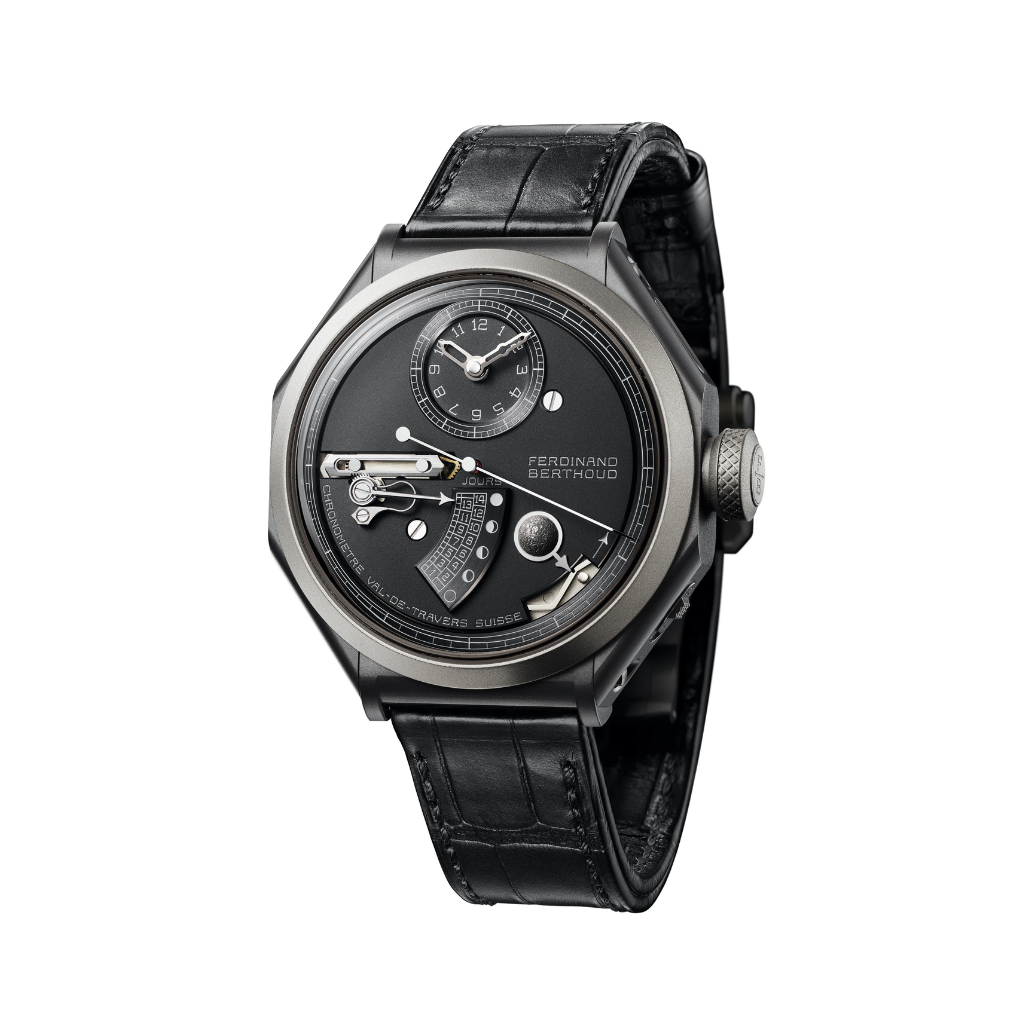
Ferdinand Berthoud was one of the greatest marine chronometer makers of the 18th century. The modern manufacture that carries his name, revived in 2015 under the Chopard group, produces watches that treat his legacy not as branding but as genuine technical inspiration.
The FB 1L is built around two complications that Berthoud himself would have recognized: a fusée-and-chain transmission and a tourbillon. The fusée-and-chain is one of the oldest solutions in horology to the problem of varying mainspring tension. A small chain, finer than many necklaces, transfers power from the barrel to the movement via a cone-shaped fusée that mechanically compensates for the changing force of the unwinding spring. The result is consistent torque delivered to the escapement throughout the entire power reserve.
Combined with a tourbillon and housed in a case that references the shape of 18th-century marine chronometers, the FB 1L is a direct line between the golden age of precision timekeeping and modern manufacturing capability. Each watch is produced in extremely limited numbers. Additionally, the level of finishing — visible through sapphire crystals on both sides — reflects a commitment to hand craft that places Ferdinand Berthoud firmly among the finest independent manufactures working today.
Why it matters: The FB 1L is the answer to anyone who asks whether historical watchmaking traditions still have a place in contemporary horology. They do — and they are more relevant, and more beautiful, than ever.
Key details: Fusée-and-chain, tourbillon, in-house manufacture, limited production, 18K gold case options.
10. Jacob & Co. Astronomia Tourbillon — Watchmaking as Theatre
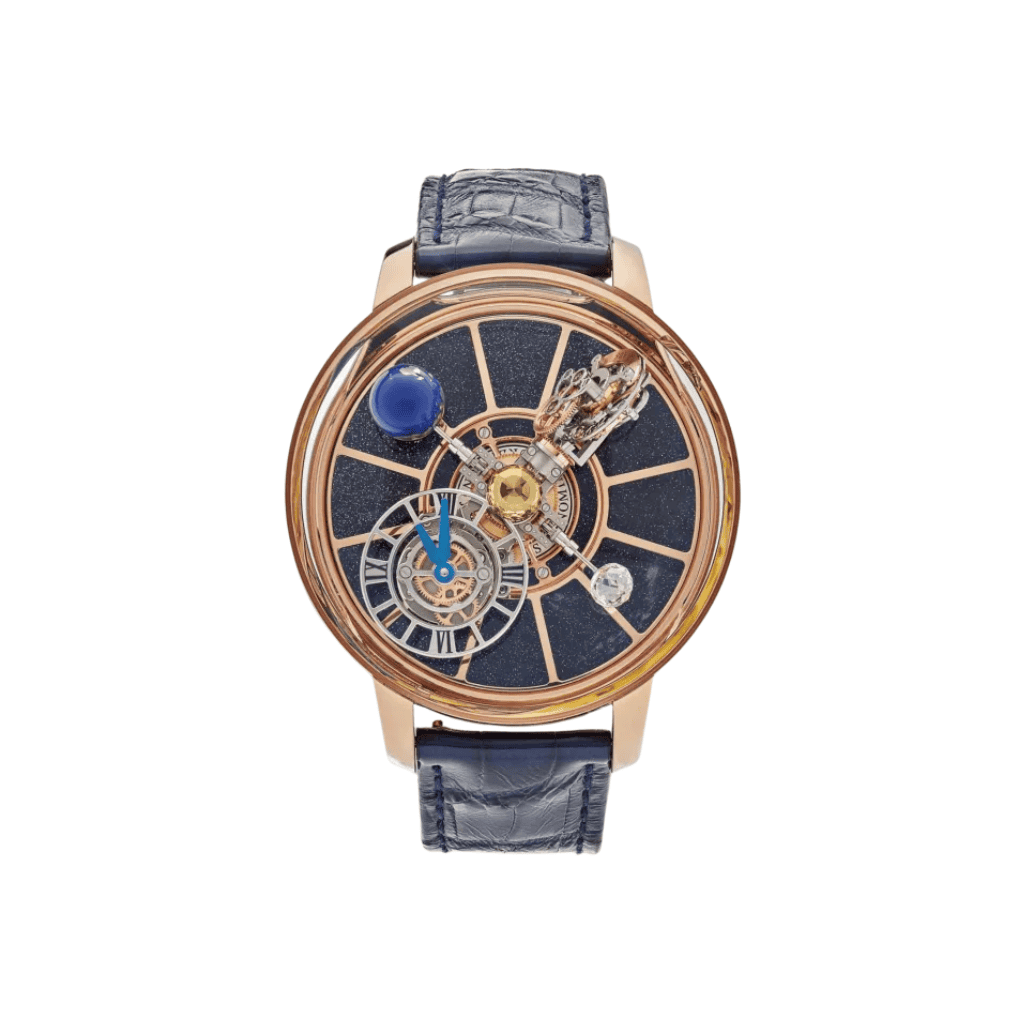
Every list of important collector watches needs one piece that refuses to play by the rules of traditional horology. The Jacob & Co. Astronomia Tourbillon is that piece. It does not try to be subtle. It does not aspire to restraint. Instead, it builds a miniature solar system inside a watch case and makes absolutely no apology for it.
Four elements orbit the dial on two rotating arms: a time display with Roman numerals, a blue rotating Earth globe, a precision-cut diamond, and a triple-axis tourbillon. The entire assembly makes one full rotation every 20 minutes, ensuring that the watch is never the same object twice in the same conversation. Furthermore, the triple-axis tourbillon — rotating simultaneously on three perpendicular axes — is one of the most technically demanding complications in contemporary watchmaking.
The Astronomia is not a watch for the collector who wants understatement. However, it is absolutely a watch for the collector who wants to own something genuinely unlike anything else. It represents a philosophy of watchmaking that prioritizes spectacle alongside technical ambition, and it does so with a level of mechanical sophistication that earns the visual drama rather than simply relying on it.
Why it matters: The Astronomia Tourbillon proves that watchmaking and kinetic art are not mutually exclusive. For collectors who want a piece that commands a room while concealing extraordinary engineering, nothing else comes close.
Key details: Triple-axis gravitational tourbillon, rotating globe, diamond, 20-minute dial rotation, rose gold case, hand-wound.
What These Ten Watches Have in Common
At first glance, this list spans enormous stylistic and technical territory. A steel sports watch from Geneva sits alongside a kinetic sculpture from New York. A Finnish craftsman producing fifty pieces a year sits alongside one of the world’s largest watch groups. However, all ten watches share one quality: they reward the collector who pays attention.
The Nautilus rewards an understanding of design history. The Résonance rewards an understanding of physics. The Crash rewards a willingness to abandon function as the primary measure of value. The Voutilainen rewards patience and relationship. Together, they map the territory of serious collecting more completely than any single piece ever could.
Moreover, each of these watches holds its value differently. Some are established auction performers. Others are too rare to appear at auction regularly. A few trade almost entirely through private networks. Understanding why each watch commands the attention it does is itself a significant part of what collecting at this level actually means.
Building a Collection Around These References
If you are building a collection with these ten watches in mind, a few practical points are worth noting.
First, many of these pieces are not available through standard retail channels. The Voutilainen, the Ferdinand Berthoud, and the F.P. Journe references all require direct relationships with the brand or an authorized boutique. Starting those conversations early matters.
Second, condition and completeness are critical across all ten references. Box, papers, original straps, and service history all affect secondary market values significantly. Additionally, for pieces like the Patek Philippe 5711, the difference between a complete set and a watch alone can represent a very significant price gap.
Finally, buying with genuine understanding always produces better outcomes than buying based on trend alone. The watches on this list are not interchangeable status symbols. Each one represents a specific point of view about what watchmaking is for. Knowing which point of view resonates with you is the beginning of a real collection.
Quick Reference Summary
- Patek Philippe Nautilus 5711/1A — The definitive steel sports watch
- Patek Philippe Nautilus 5711/1P — The platinum pinnacle of the Nautilus line
- F.P. Journe Chronomètre à Résonance — The resonance movement, realized
- F.P. Journe Tourbillon Souverain — Tourbillon with constant force, done right
- Cartier Crash — Wearable sculpture, 1967 to present
- Richard Mille RM 67-02 — Aerospace engineering on the wrist
- Audemars Piguet Royal Oak 15407ST — The skeletonised icon in steel
- Kari Voutilainen 28 Sport — Independent watchmaking at its finest
- Ferdinand Berthoud FB 1L — History, fusée-and-chain, and a tourbillon
- Jacob & Co. Astronomia Tourbillon — Kinetic art and grand complication combined