
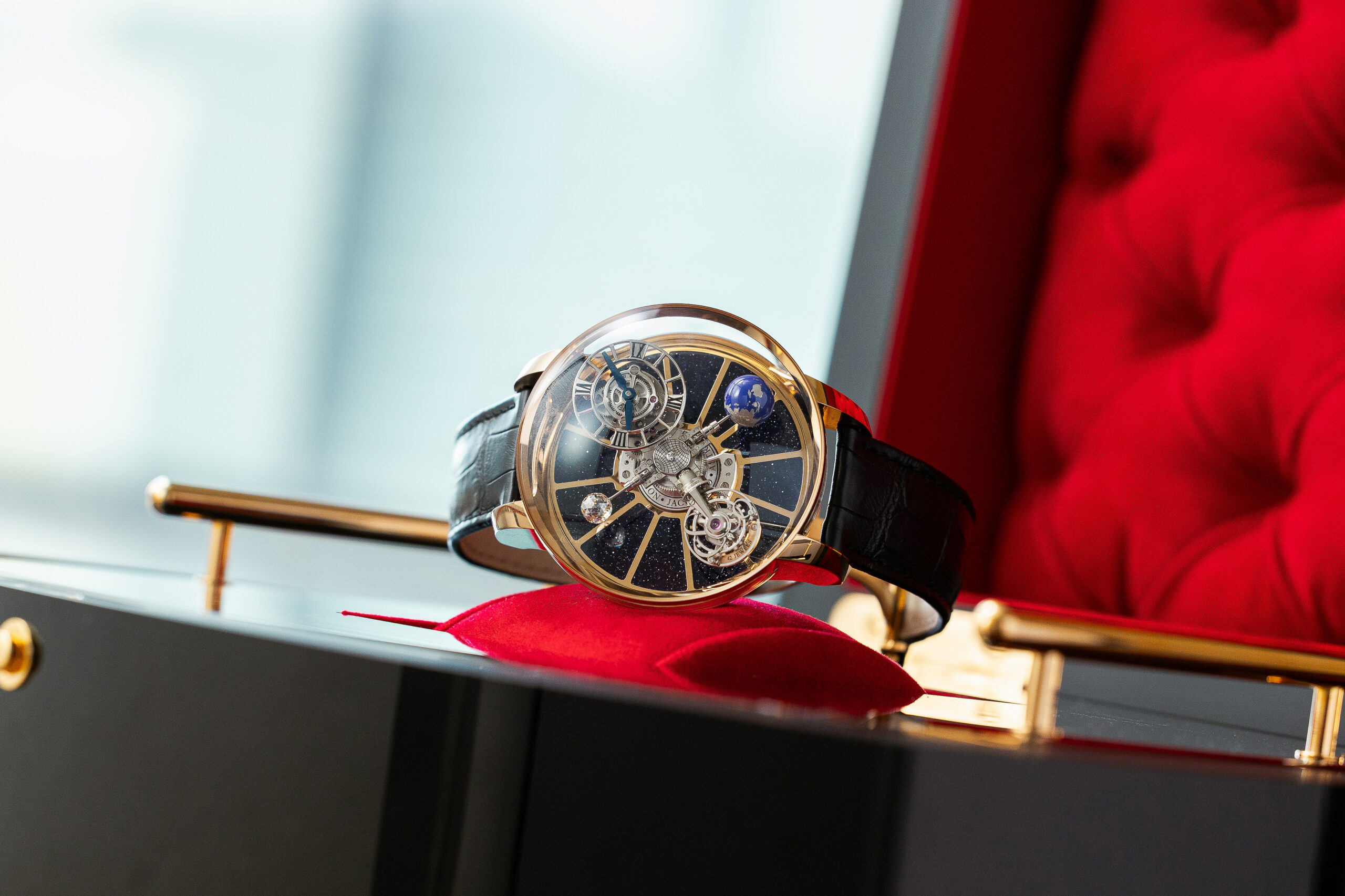
Jacob & Co. · Astronomia Collection · Rose Gold · One-of-a-Kind
Some watches tell the time. The Jacob & Co. Astronomia Tourbillon tells a story about the cosmos itself, and it does so while moving, spinning, and rotating in front of your eyes every single second. This particular example carries something even rarer than the Astronomia name alone: it is a Pièce Unique, a genuine one-of-a-kind creation, confirmed by the engraving on its caseback. There is no second watch like this one anywhere in the world.
This guide walks through what makes the Astronomia Tourbillon such an extraordinary piece of modern horology, from its triple-axis tourbillon to its rotating celestial globe, and explains why Jacob & Co. considers this collection less a watch and more a wearable planetarium.
What Is the Astronomia? A Different Philosophy of Watchmaking
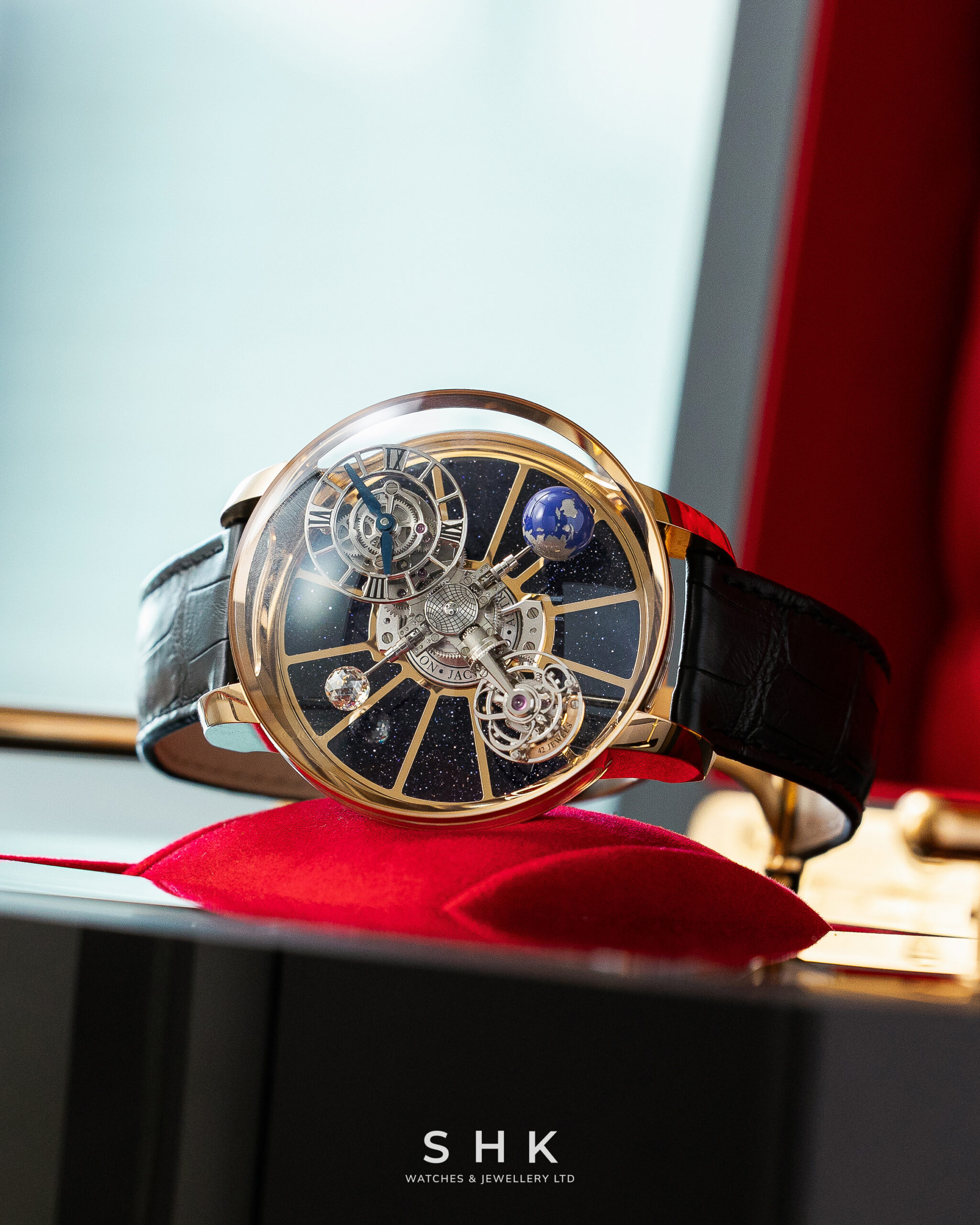
Jacob Arabo first introduced the Astronomia in 2014, and the concept was unlike anything else in watchmaking at the time. Rather than displaying time through static hands on a flat dial, the Astronomia builds a miniature solar system inside the case. Multiple arms extend from a central rotating platform, each one carrying a different celestial element. As a result, the entire mechanism behaves more like an orbiting model of the universe than a traditional watch movement.
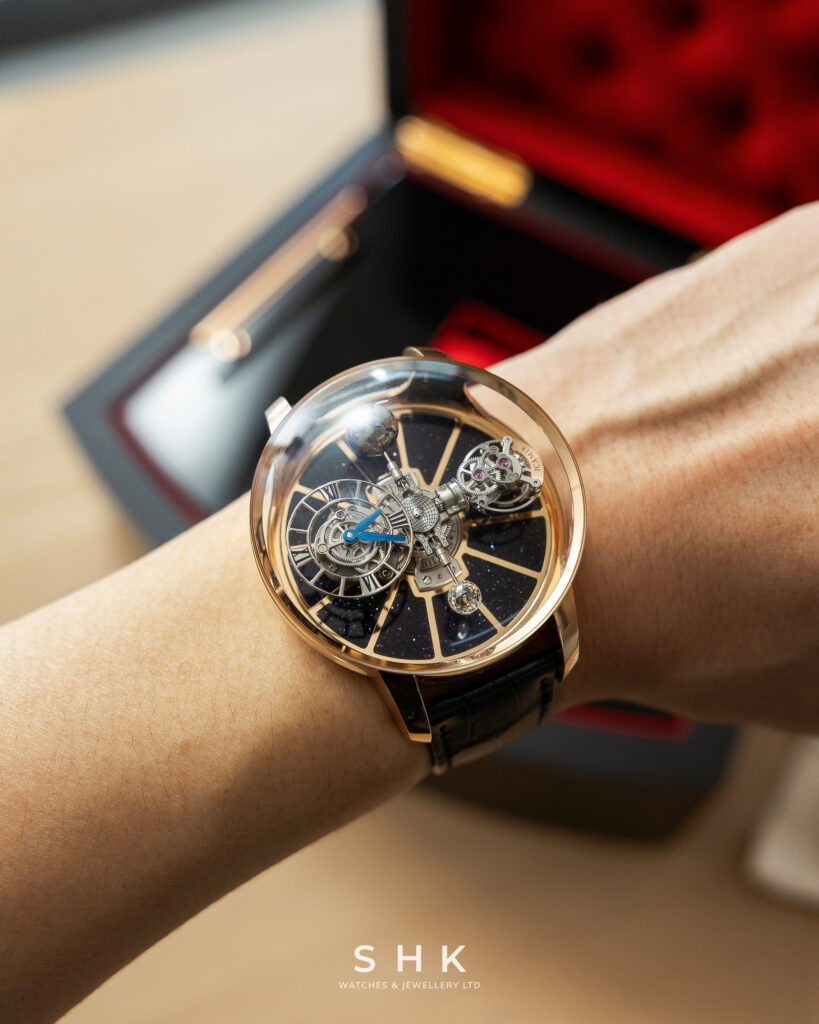
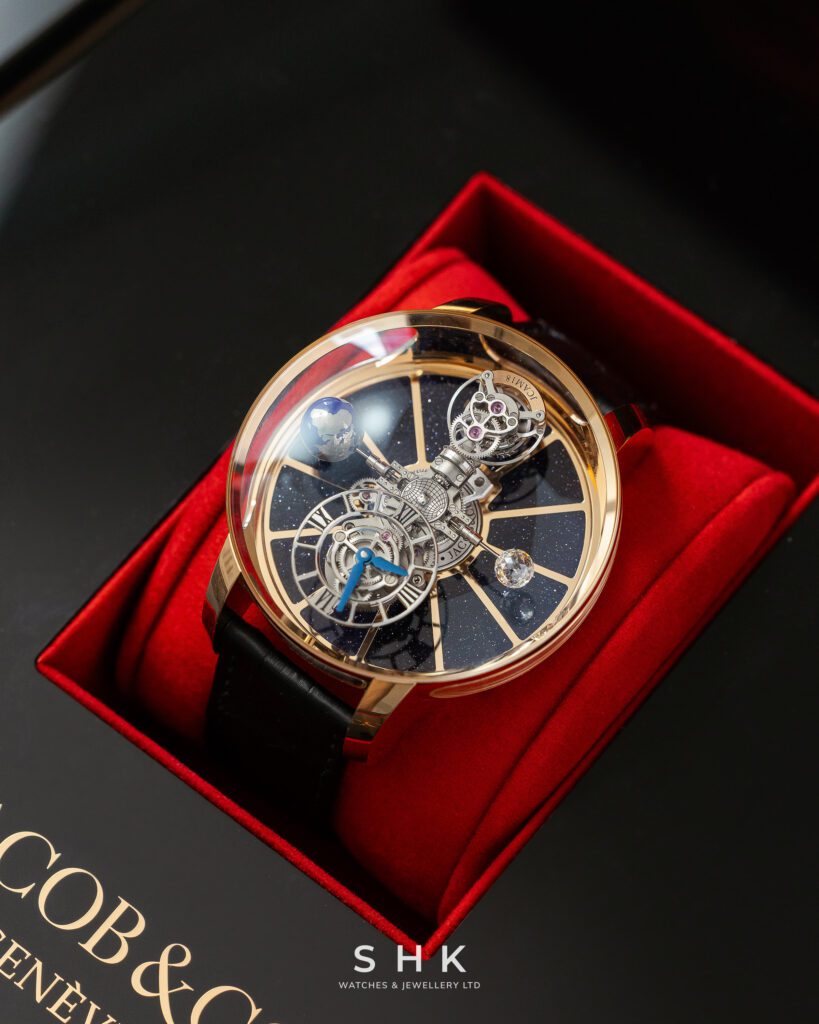
On this particular piece, four key elements share the dial in a cross-shaped layout. A small subsidiary dial with Roman numerals displays the hours and minutes. A rotating globe, finished in deep lapis-blue tones, represents the Earth. A faceted diamond, cut to catch and scatter light from every angle, represents a celestial body in motion. And at the centre of it all sits the tourbillon itself, fully exposed and visibly alive.
The Triple-Axis Tourbillon: Watchmaking’s Most Demanding Complication
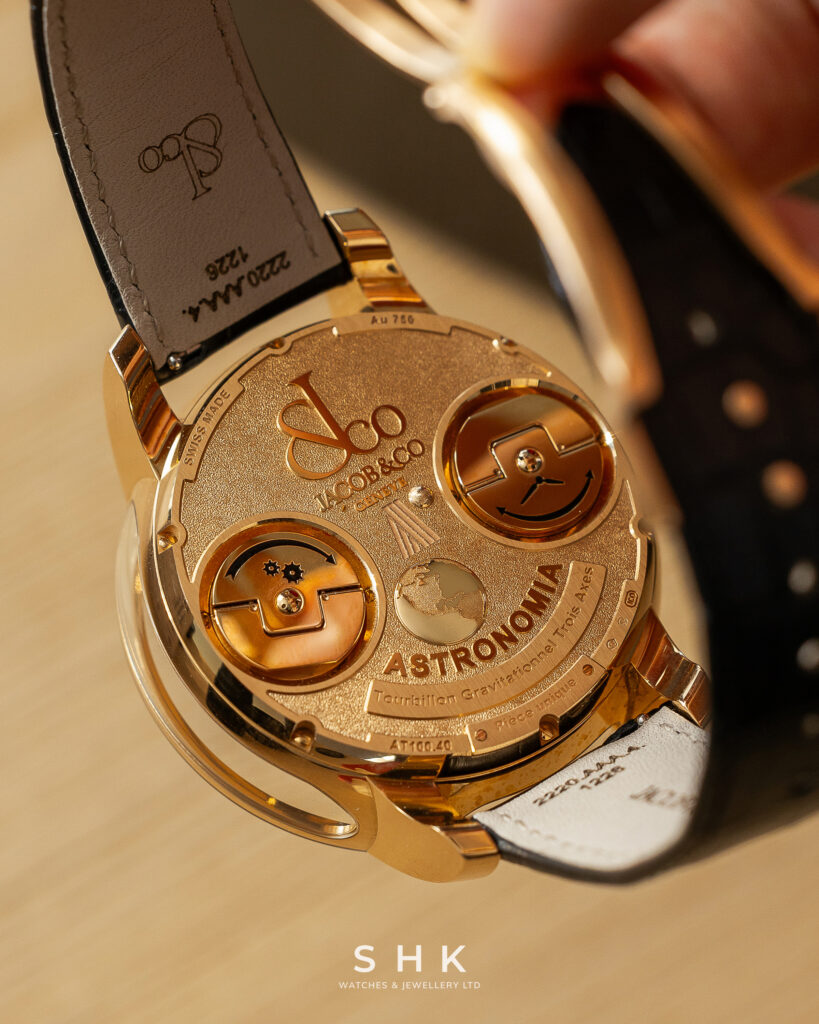
The caseback of this watch confirms exactly what kind of tourbillon sits inside: a Tourbillon Gravitationnel Trois Axes, meaning a triple-axis gravitational tourbillon. A standard tourbillon rotates on a single axis to counteract the effects of gravity on a watch’s accuracy. A triple-axis tourbillon takes this concept dramatically further, rotating the escapement around three separate axes simultaneously.
This is widely regarded as one of the most technically demanding complications a watchmaker can produce. Each additional axis introduces new engineering challenges around component balance, energy transfer, and structural integrity, all while keeping the entire assembly light enough to rotate smoothly without consuming excessive power. The caseback engraving also confirms this example is marked “Pièce Unique,” officially designating it as a single, unrepeated creation rather than part of a limited series.
The Rotating Celestial Globe and Diamond
Beyond the tourbillon, two additional elements orbit the dial independently. The globe, rendered in a deep blue with continents mapped across its surface, sits opposite the tourbillon on the cross-shaped arm structure. Meanwhile, a precision-cut diamond occupies another arm, positioned to catch light constantly as the entire assembly rotates.
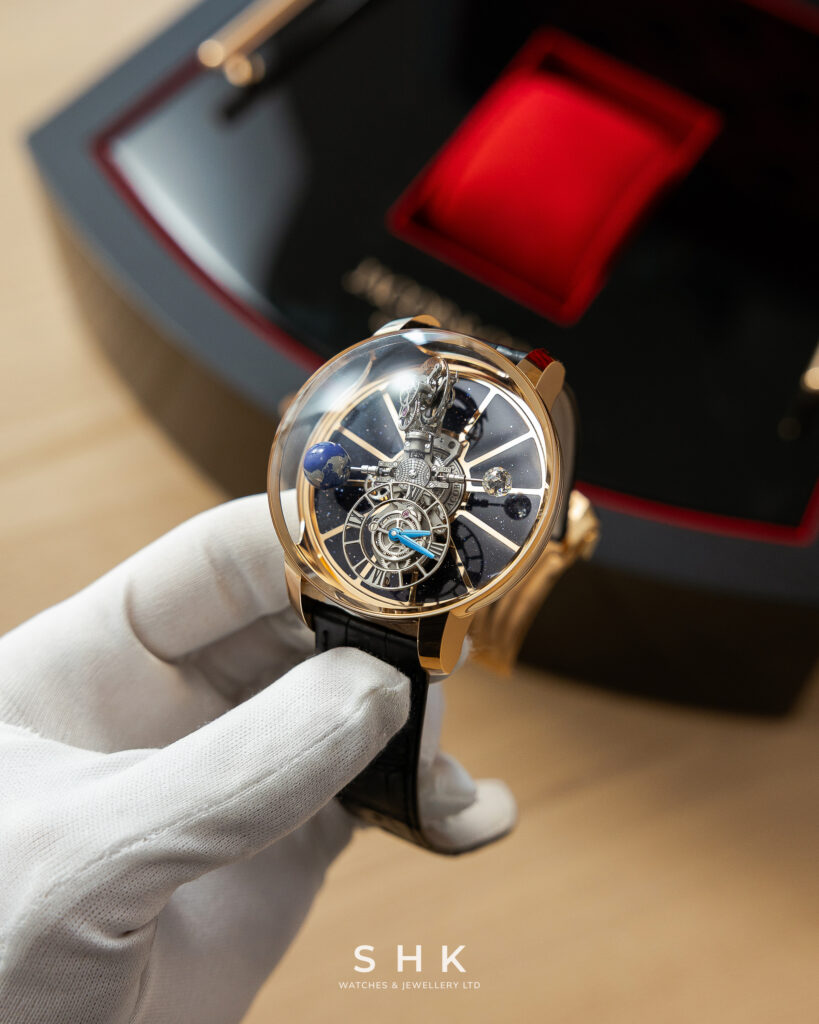
The dial background itself uses a deep blue aventurine-style finish, flecked with tiny points that mimic a starfield. This is not a coincidence. Jacob & Co. designed the entire visual language of the Astronomia around the theme of space exploration, and the starfield backdrop reinforces that theme every time the watch catches light. Against this backdrop, the polished metal arms, the blue globe, and the sparkling diamond all appear to drift through their own miniature cosmos.
Engineering a Watch That Performs Like a Kinetic Sculpture
One of the most remarkable aspects of any Astronomia is how much genuine engineering sits behind what initially reads as pure spectacle. Every rotating element on the dial must be balanced precisely against the others. If one arm were even slightly heavier than intended, the entire assembly would consume power unevenly and risk losing accuracy or stopping prematurely.
Jacob & Co. addresses this through meticulous material selection. Lightweight components, including magnesium and titanium in various Astronomia references, allow the rotating structure to move smoothly without overburdening the mainspring. Despite the visual complexity, the underlying goal remains the same as any fine watch: reliable, accurate timekeeping, just achieved through a dramatically different mechanical philosophy than a traditional dial and hand-set.
The Presentation: A Box Built for a Singular Watch
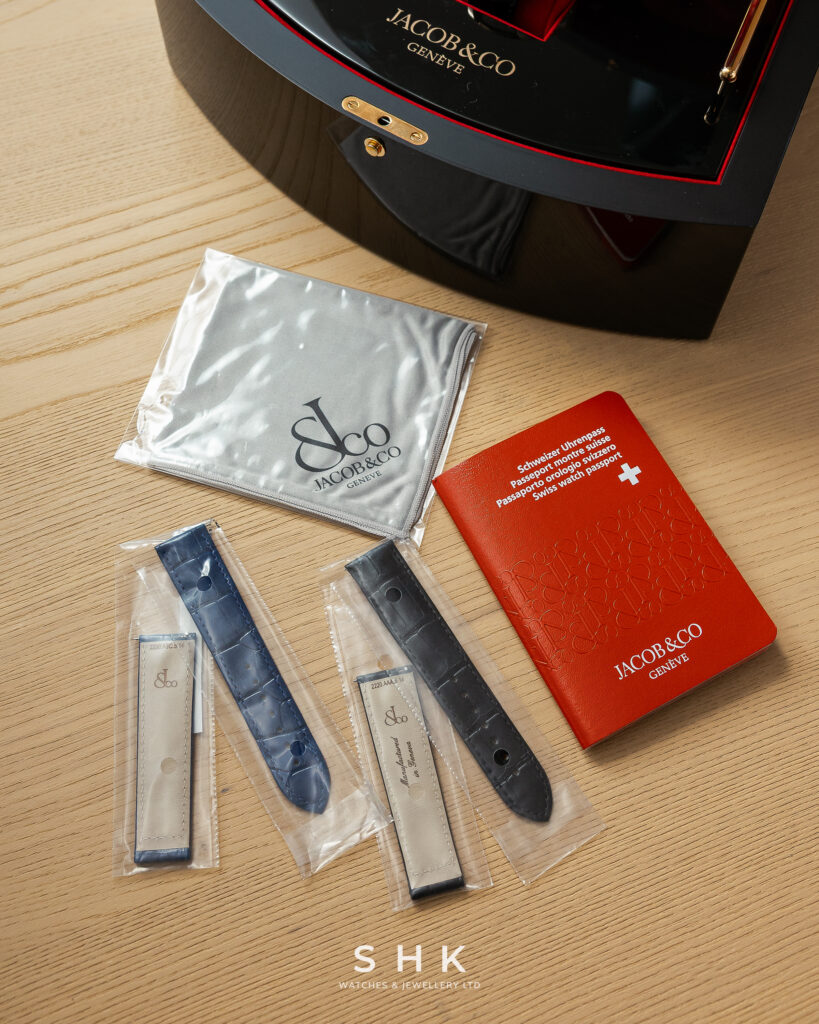
Given the rarity of a Pièce Unique commission, the accompanying presentation matches the significance of the watch itself. This example arrives with its full Jacob & Co. travel case, a branded cleaning cloth, two additional alligator leather straps in contrasting colourways, and the Swiss Watch Passport, a document used across the Swiss watchmaking industry to formally certify a timepiece’s authenticity and provenance.
The inclusion of multiple straps signals an important detail. Pièce Unique commissions are often built directly with input from the original client. The strap options included with this piece suggest the original commission anticipated multiple wearing contexts, from formal black to a more relaxed alternative tone.
Why Pièce Unique Matters
In a world of limited editions numbering in the dozens or even hundreds, a true Pièce Unique occupies an entirely different category of rarity. The caseback engraving on this Astronomia Tourbillon does not list a production number out of a series total, because there is no series. This is the only one. Consequently, owning this watch means owning a creation that Jacob & Co. will never produce again in this exact configuration, materials, and finishing.
This level of exclusivity typically emerges from a direct relationship between the brand and a client who commissions a bespoke creation, often incorporating personal material preferences, colour choices, or design elements not found in any catalogued reference. While Jacob & Co. does not always publicly disclose every detail behind a Pièce Unique commission, the caseback marking alone confirms its status beyond any doubt.
Quick Specifications
- Model: Astronomia Tourbillon
- Designation: Pièce Unique (one-of-a-kind)
- Case Material: 18-carat rose gold (Au 750)
- Movement: Manual or automatic Jacob & Co. manufacture calibre (Astronomia family)
- Complication: Triple-axis gravitational tourbillon (Tourbillon Gravitationnel Trois Axes)
- Dial Elements: Rotating hour/minute display, rotating celestial globe, rotating precision-cut diamond
- Dial Background: Aventurine-style starfield finish
- Strap: Alligator leather, additional colourways included
- Presentation: Full Jacob & Co. travel case, cleaning cloth, Swiss Watch Passport
- Reference Marking: AT100.40 (caseback)
- Availability: Available at SHK Watches
Final Thoughts
The Jacob & Co. Astronomia Tourbillon Pièce Unique represents watchmaking pushed toward its most theatrical and technically ambitious extreme. It is not a watch designed for subtlety, nor does it pretend to be. Instead, every rotating arm, every faceted diamond, and every gravitational tourbillon axis works together to create something closer to a wearable kinetic sculpture than a conventional timepiece.
For collectors who already understand and appreciate complicated watchmaking, the Astronomia represents one of the boldest interpretations of what a wristwatch can be. And as a genuine Pièce Unique, this particular example carries a level of exclusivity that very few watches, regardless of price or complication, will ever match.