
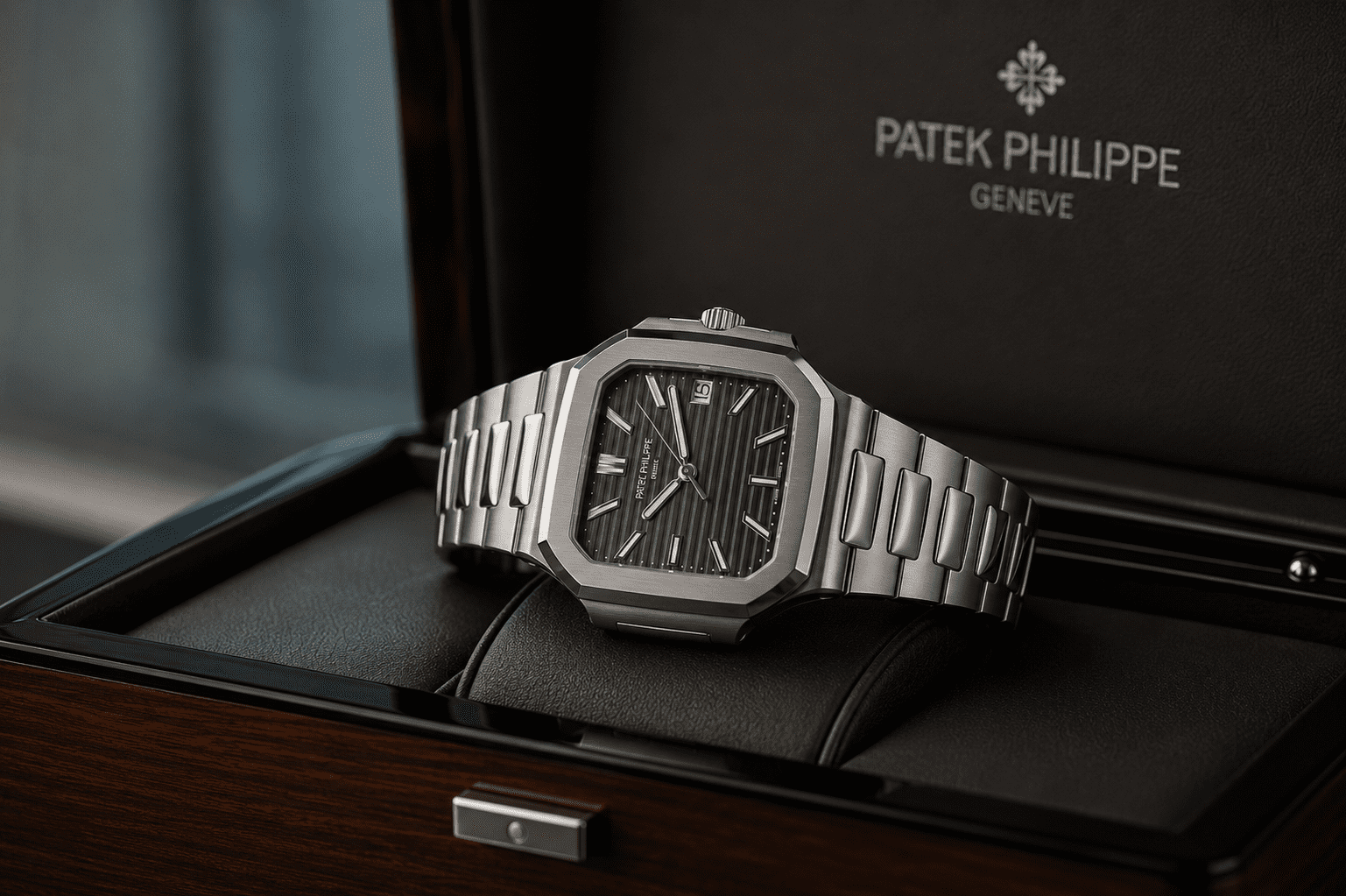
There is a particular kind of silence in Geneva. Not the silence of inactivity, but the silence of deep, unhurried craft — the kind that stretches across years, even decades, before it finally speaks. For twenty-five years, Patek Philippe said nothing new. And then, in 2024, they said something that sent the watch world into a frenzy: Cubitus.
The last time Patek Philippe launched an entirely new watch family, the year was 1999 and the collection was the Twenty~4. Before that, the Nautilus in 1976 and the Aquanaut in 1997. These are not merely watches — they are cultural moments, objects that define an era. The Cubitus arrives with a weight of expectation almost impossible to meet. And yet, it does something more interesting than meeting expectations: it reframes them entirely.
Drawing from Patek’s own Art Deco archives, the Cubitus case is built around a geometry that is simultaneously ancient and radical. It is square, but its corners soften into curves. It references the octagon, nods to the circle, and then commits fully to none of them. The result is a shape that feels genuinely original — not borrowed from the Royal Oak, not echoing the Nautilus, not a riff on the Calatrava. It is simply, unmistakably, itself.
Design Philosophy: Fifty-Five Operations for a Case the Eye Reads as Effortless
There is an almost perverse luxury in the Cubitus case. It looks clean. The lines are clear. The proportions feel obvious — as if the watch could only ever have looked this way. And then you learn that achieving this apparent simplicity requires approximately 55 separate manual operations.
The surfaces alternate between polished chamfers and vertical satin-brushed flanks, creating a play of light that changes with every movement of the wrist. At 45mm, the case is generous and assertive — yet its slimness (just 8.3mm on the steel models) means it disappears onto the wrist in a way large watches rarely do. The horizontally embossed dial pattern, a Patek signature language shared with the Nautilus, adds a textile quality that catches light without shouting for attention.
The integrated bracelet or strap is conceived as part of the case architecture rather than an accessory to it. Flush transitions, refined clasp mechanisms, a lockable micro-adjustment system on the steel bracelet — these are not incidental details. They are the difference between a watch that is merely expensive and one that feels inevitable.
The Three References
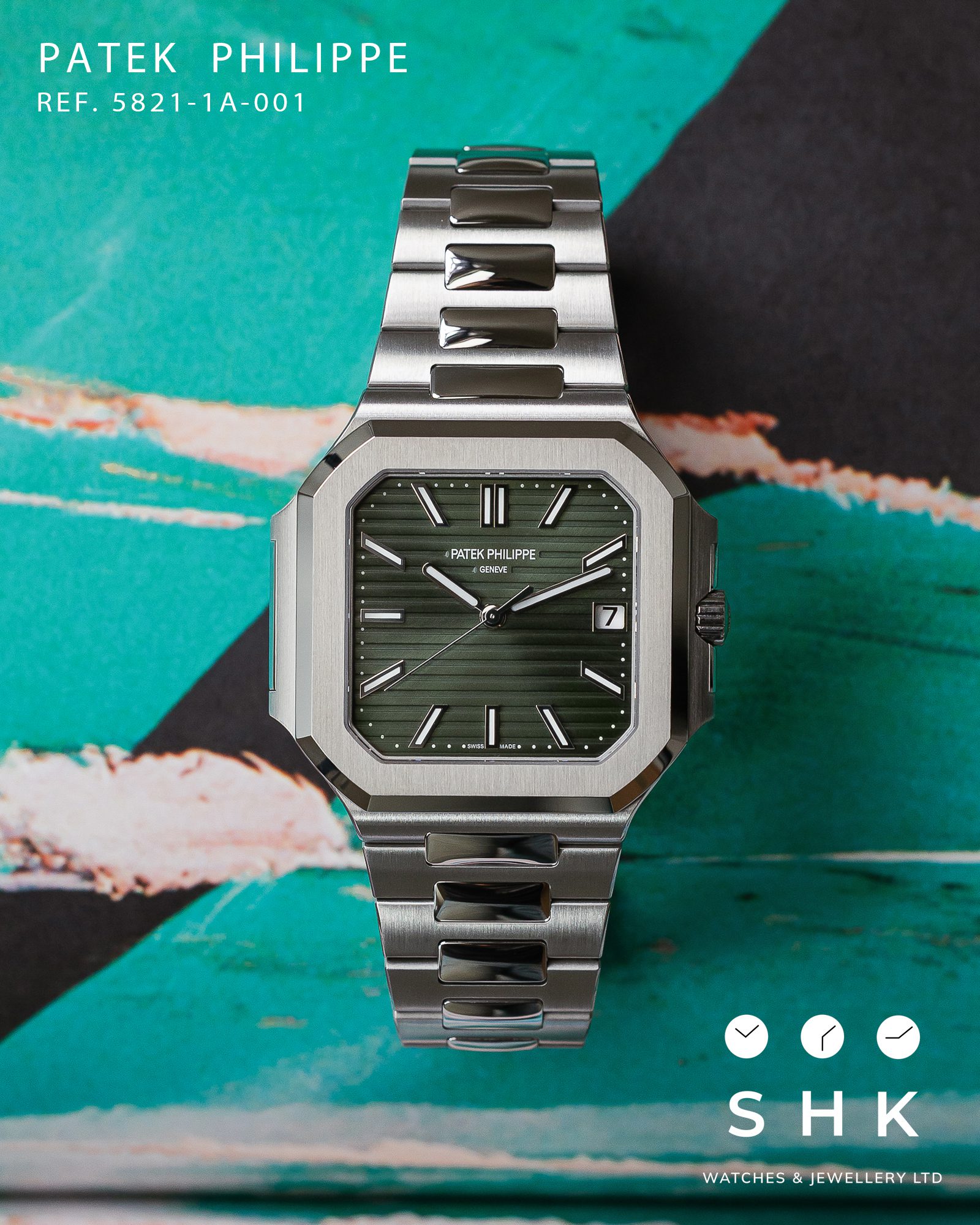
Ref. 5821/1A-001 — Stainless Steel: The Sporting Heart
If the Cubitus has an entry point — and at just over forty thousand dollars it is a very elevated entry point — it is the stainless steel reference with the olive green dial. The colour is confident without being theatrical: warm enough to feel organic, muted enough to pair with virtually anything.
The caliber 26-330 S C inside is a proven self-winding movement, fitted here with a stop-seconds feature that allows time to be set to the precise second. A transparent sapphire caseback reveals a 21K gold rotor engraved with the same horizontal motif as the dial — Patek’s way of ensuring that the movement is as considered as the face. The steel integrated bracelet is fitted with a patented fold-over clasp and a micro-adjustment system operated by a lever. It is, in every sense, the everyday Cubitus.
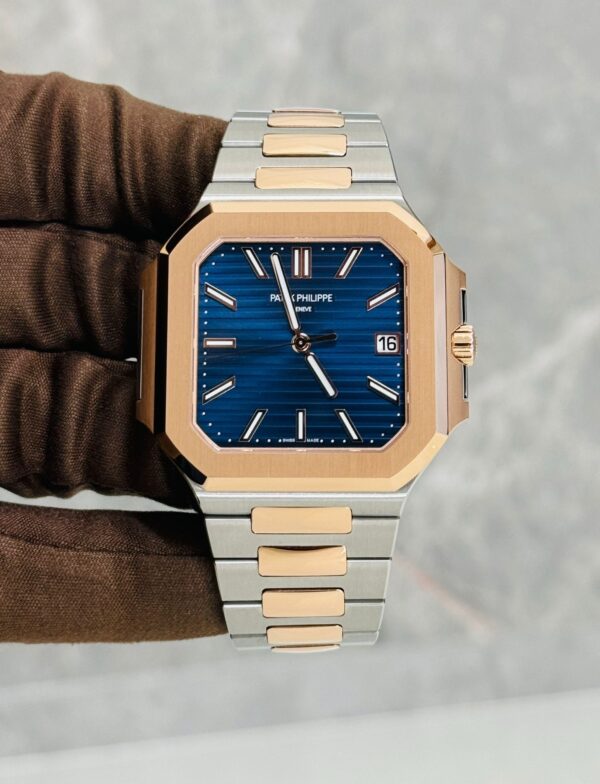
Ref. 5821/1AR-001 — Steel & Rose Gold: The Social Chameleon
Two-tone watches occupy a curious position in horological culture. They can feel dated — a relic of a certain era’s excess — or they can feel precisely right, the warmth of gold tempering the austerity of steel. The 5821/1AR lands firmly in the latter category. Here, rose gold is used not as ornamentation but as architecture: it frames the case, accents the bracelet links, and gives the sunburst blue dial a sunset quality that shifts from cool to warm depending on the light.
Mechanically, it shares the 26-330 S C movement with its steel sibling. Where it differs is in presence: this is a watch that announces itself at dinner without apologising for its formality at the weekend. The matching cufflinks Patek offers alongside it are, characteristically, an understated master class in coordinated luxury.
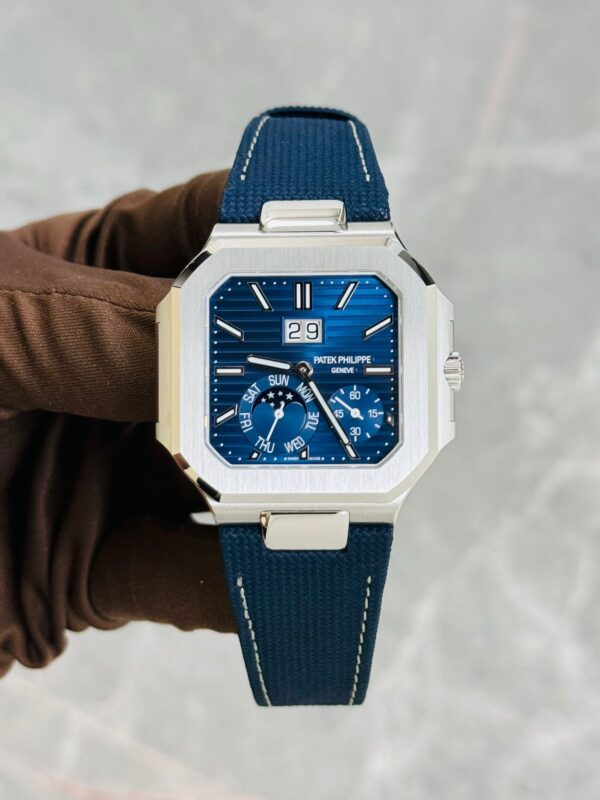
Ref. 5822P-001 — Platinum: The Flagship Statement
This is where the Cubitus becomes undeniable. The 5822P-001 is not merely a watch with extra complications — it is the reason the Cubitus collection exists: a proof-of-concept for what the new case architecture can carry when Patek’s deepest watchmaking resources are brought to bear upon it.
The caliber 240 PS CI J LU is entirely new, a development that required six separate patent filings. Built on the foundation of Patek’s legendary ultra-thin 240 base caliber, it achieves instantaneous jumping displays for the grand date, the day, and the moon phase. Instantaneous means precisely that: the display snaps forward at midnight in a single, immediate motion rather than creeping through the transition. The moon phase mechanism is accurate to one day’s error across 122 years.
The platinum case frames a navy blue sunburst dial with a quiet authority that only platinum achieves — denser in colour than white gold, cooler than steel, with a weight on the wrist that reminds you constantly what you are wearing. The 22K gold mini-rotor is visible through the sapphire caseback, a kinetic jewel spinning within a mechanical poem.
Verdict: A Collection That Earns Its Twenty-Five Years of Silence
The question that hovered over the Cubitus before its announcement was simple: does Patek Philippe need a new collection? The brand’s existing references — the Calatrava, the Nautilus, the Grand Complications — represent some of the most coveted watches on earth. Why risk dilution?
The answer, after reflection, is clear: Patek did not need a new collection. They wanted to make one. And that distinction matters enormously. This is not a market-reactive product designed to chase trends. It is a statement of artistic will — a brand choosing to explore a different geometric language because it found something genuinely beautiful in that exploration.
Will the detractors come? They always do, for anything new from a house this reverent. Some will find the 45mm case too large, the square geometry too aggressive, the departure from Patek’s round-case legacy too jarring. But for those who have always found the Nautilus almost-right-but-not-quite, or who have wanted a Patek that felt less like a boardroom and more like a conversation, the Cubitus offers something rare: genuine novelty from a brand that has earned the right to it.
Twenty-five years between ideas is not hesitation. It is the time it takes to be certain.
The Cubitus is not the most complicated watch Patek Philippe has ever made. It is not the thinnest or the rarest. But it may be the bravest — a brand at the very summit of its craft deciding, after a quarter century of silence, that it had something new to say. And saying it in the shape of a square.